

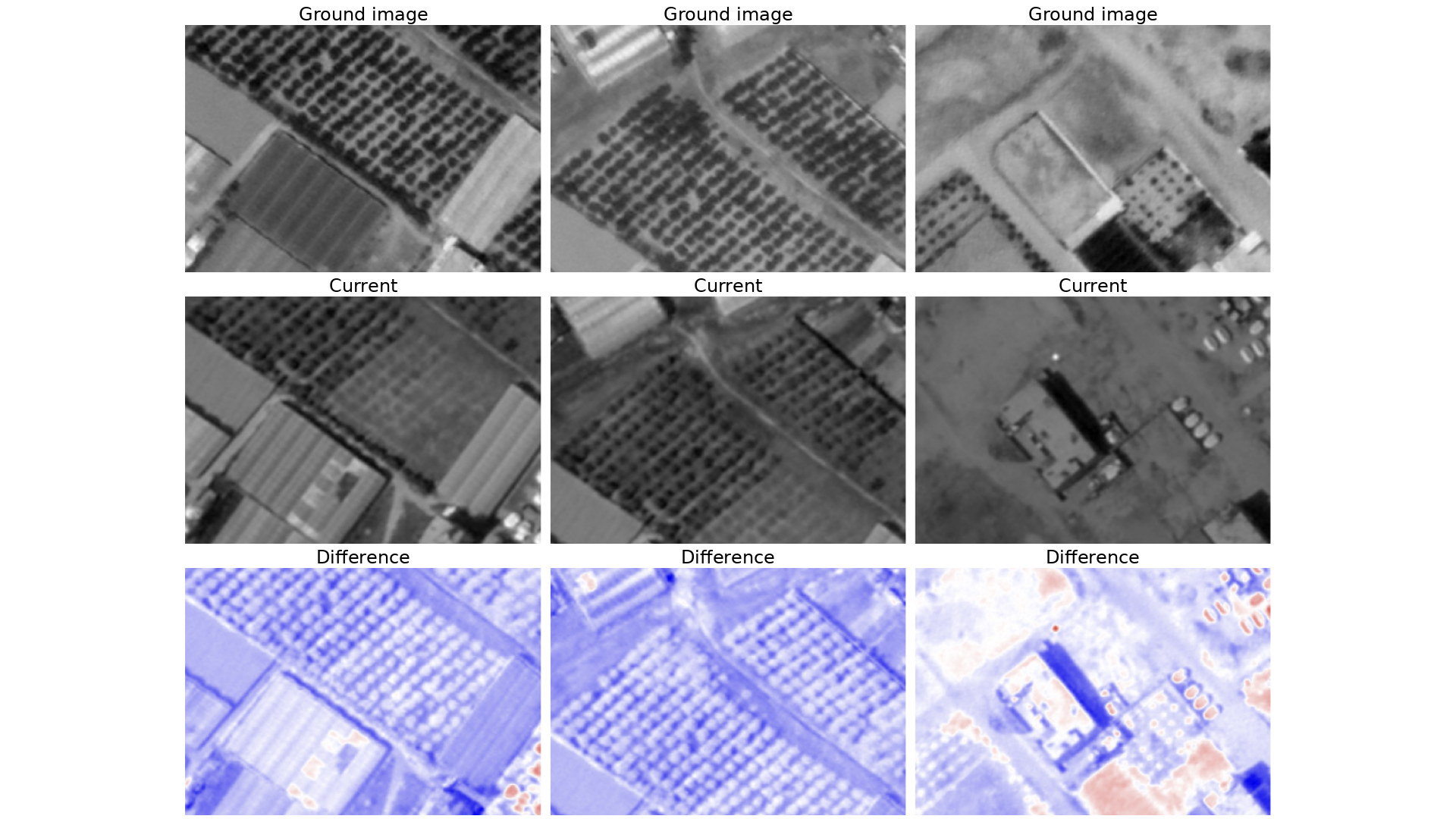
A targeting system and a forensic investigation both begin from incomplete information. Each one has its own way of inhabiting those gaps. Take, for example, an image recognition model. It first learns from thousands of images in which a human has annotated what should be picked out, and then it confronts a world that does not always lend itself to being recognised. A forensic investigation reconstructs an event from fragments that arrive unevenly, each incomplete in its own way, and layers them so that each can make sense of the gaps the others leave.
Júlia Nueno's talk follows one of these models, developed with Forensic Architecture, to map tents in satellite imagery and read the displacement of the Palestinian population in Gaza. Identifying from the orbit requires a ground truth: a prior ground against which to compare what is seen. But, what happens when that ground has been destroyed? Can an instrument be calibrated once it has lost its reference? And what it owe to those it reduces to a white dot on the sand, or to those it does not see at all? Júlia opens up the process of developing this model and pauses on the moments when it hesitates to ask what remains of truth when the machine doubts.
Date: Thursday, November 26, 7:00pm.
Place: Nave Una in Matadero Madrid.
Language: Spanish with simultaneous translation in English.
Price: Free, no registration required.
Júlia Nueno Guitart is a researcher and engineer. Her work explores the computational systems that organise life and the spaces we inhabit, aiming to develop new ways of understanding them and acting with and through them. She is a member of Forensic Architecture and a PhD candidate at the Centre for Research Architecture, Goldsmiths (University of London), where she also teaches on the master's programme. She edited Genocidios. Una lectura forense (Galaxia Gutenberg, 2025), and her writing has appeared in The Guardian, Der Spiegel, VICE News and Springerin, among others.

 Medialab-Matadero Madrid