

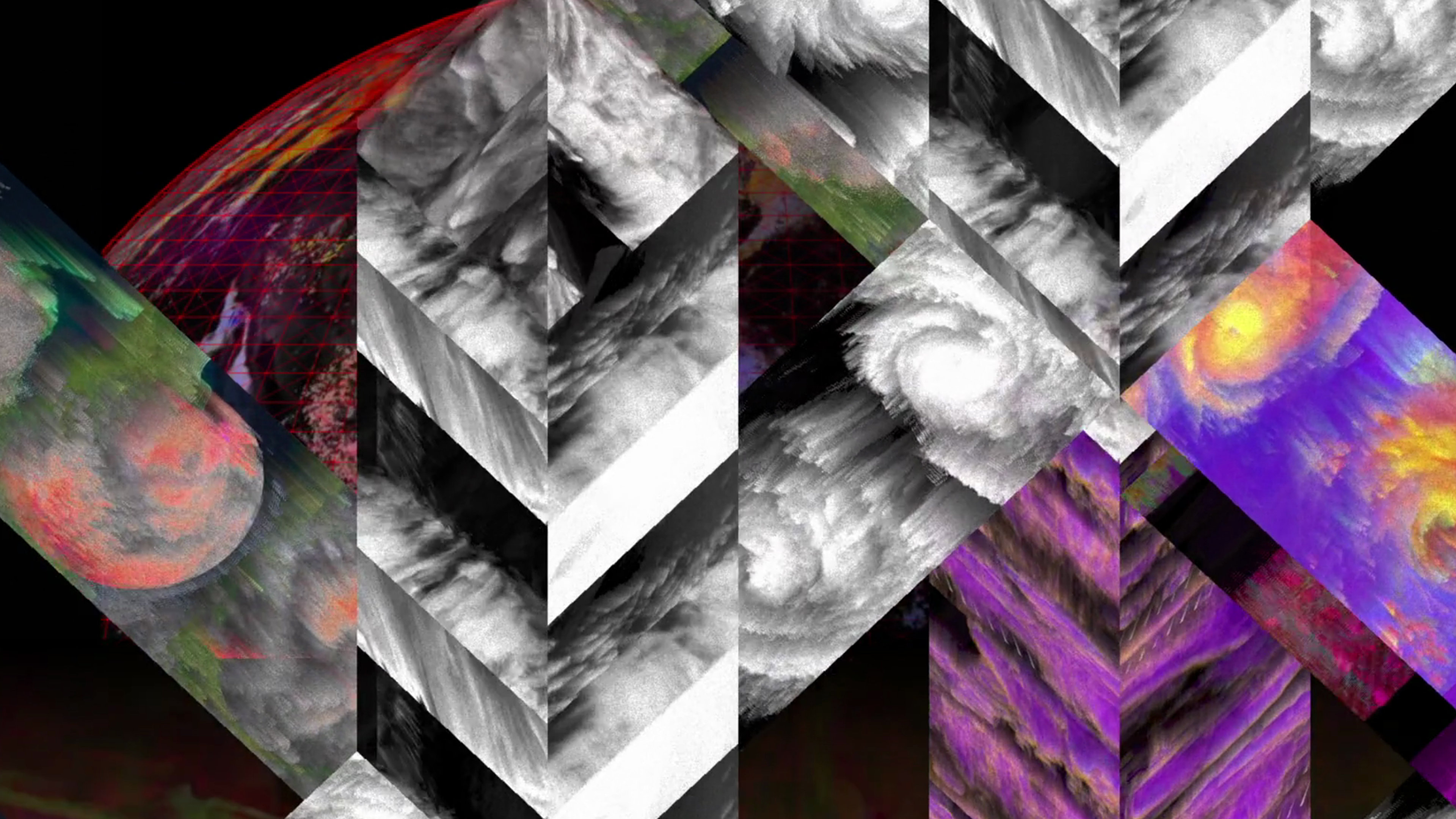
Unpredictable Atmosphere is an audiovisual and spatial installation that reimagines the web as an optical device capable of unfolding climate models in real time. It examines how AI-based climate models systematically overlook outliers – extreme atmospheric events such as hurricanes. The work exposes a structural condition embedded within contemporary AI foundation models: the privileging of statistical regularity and the marginalisation of deviation. These outliers sit at the edge of prediction, exposing the failures and blind spots of technological systems built on historical data. Yet it is within these anomalies that the atmosphere reveals its most critical transformations.
Developed in collaboration with fluid dynamics experts and climate scientists, the project spatially unfolds climate models according to their computational grid structures. Within this framework, strips of data render possible futures in which past hurricane data – outliers that escaped accurate prediction – reassemble in space through infinite combinations. The resulting simulations generate a synthetic atmosphere in which indeterminacy becomes operative, unfolding as a continuous field of variation.
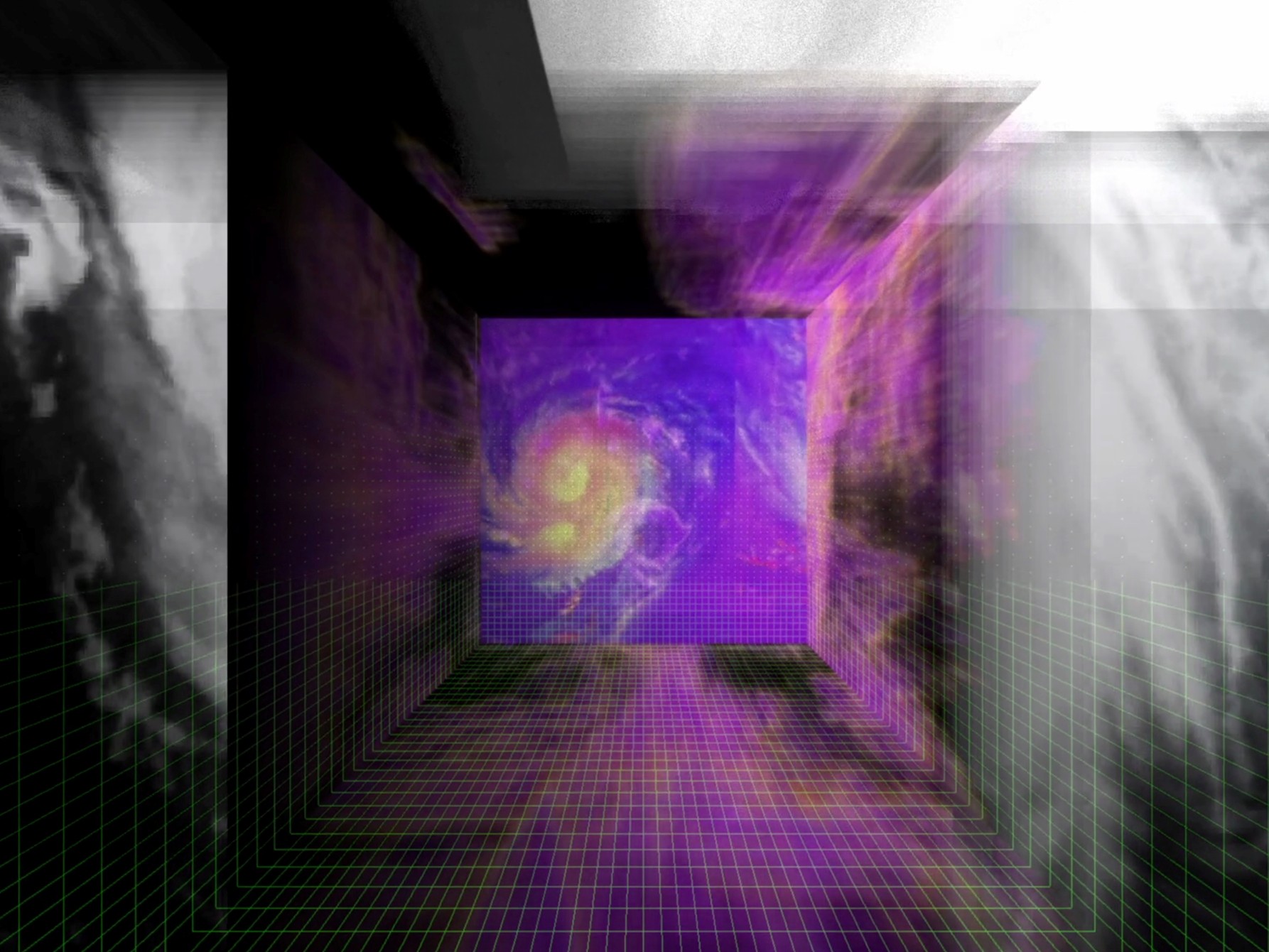
The work develops across four vertical layers of sensing and simulation: radar, aerial, orbital, and cloud. Each layer corresponds to a specific technological regime of atmospheric observation, from ground-based detection systems to satellite infrastructures and distributed AI networks. The cloud operates in a double register, as both a meteorological condition and a synthetic computational environment. These layers activate intermittently, producing a shifting configuration of perception and data processing that resists linear sequencing.
The work takes the form of a two-channel, web-based audiovisual live-simulated environment. The decision to develop the project as a web-based work responds directly to the current political climate, especially in the US, where scientific and climate data, repositories, and open databases are increasingly being removed from the internet. Hosting the project on the web becomes a strategy of resistance in the form of counter-modelling. The project also argues for the need to develop new artist-driven models that bring the urgency of open science into public discourse.
Audiovisual and spatial installation: two-channel, web-based live-simulated environment.
Lucia Rebolino is an artist, architect and research-based computational designer. She is currently a Researcher with Forensic Architecture in London.
Lucia conceives her practice as a space where different branches of science and design can conceptualize, critique, visualize and provoke new vibrant aesthetics, drawing attention to complex and invisible systems.
Her spatial and conceptual thinking is grounded in research-based practice developed during her time as Teaching Associate at Columbia GSAPP and Researcher at the Center for Spatial Research in New York, testing new tools in investigative projects, exploring data visualization, and new counter-cartography aesthetics. Since 2023, Lucia has been a Researcher with Forensic Architecture, working across cartography, remote sensing, and web platforms in support of environmental justice and human rights investigations.

 Medialab-Matadero Madrid