

Exocapitalism is the idea that capitalism doesn't belong to us: that it works as a form, almost like an algorithm, and could keep working without us. The seminar runs through several of its core mechanisms – Lift and Fold – before turning to the concept of the Superdark Factory.
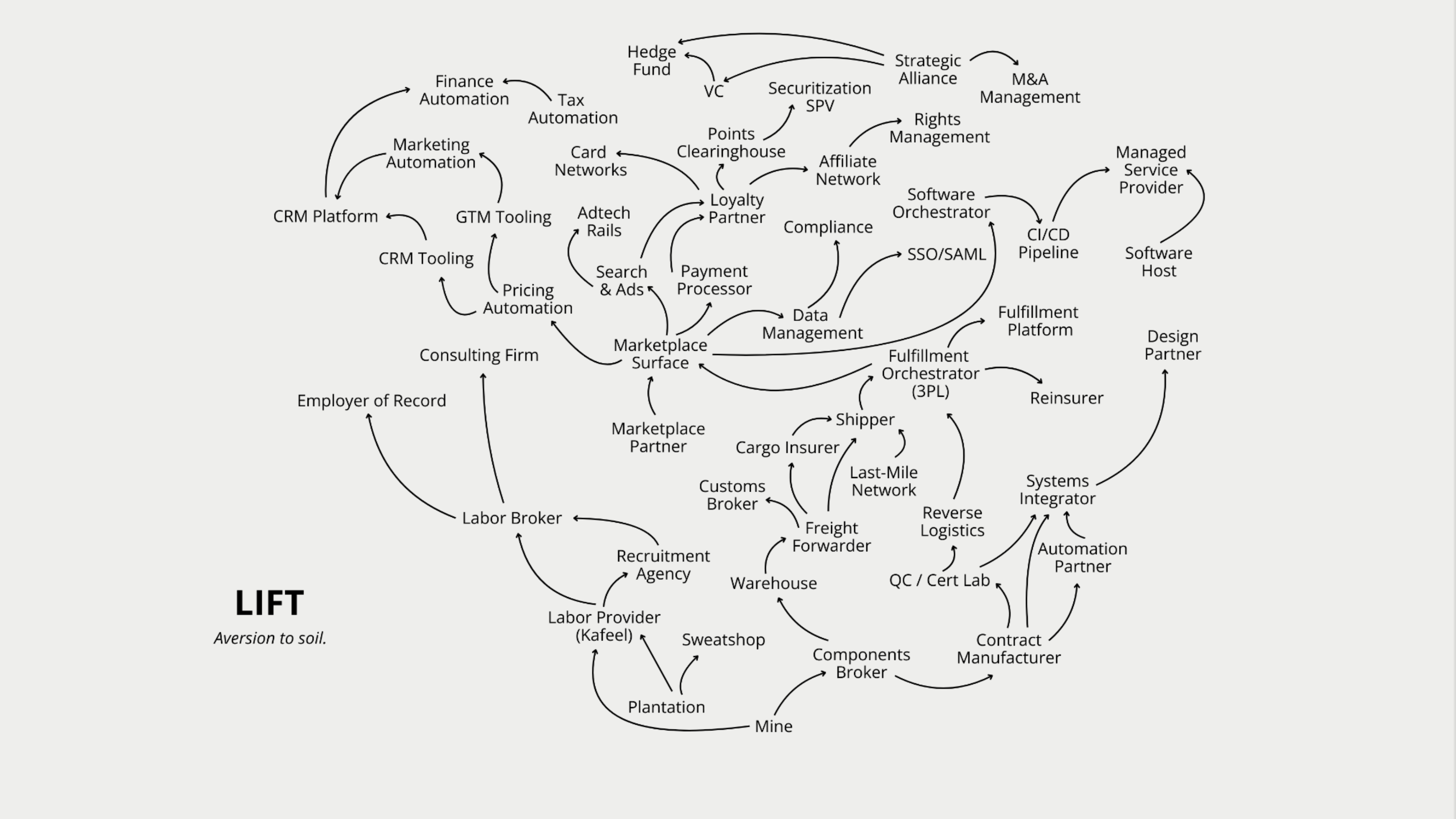
Lift is capital's tendency to pull away from fixed costs, from the ground, from the sphere of human affairs. You can see it in an airline that no longer sells seats but positions in a queue, or in a telecom operator that sells its towers and keeps using them as a tenant.
Fold is the process by which difference emerges without any change to the substrate – the lens through which we read the software economy.
We close by introducing and discussing the Superdark Factory: a factory that determines its own objectives, the automation of automation – and what it means for the future of the economy, and for anyone who sets out to govern something that keeps outrunning their ability to understand it.
Dates: Friday 16 October (16:00–20:00) + Saturday 17 October (11:00–14:00 and 16:00–20:00) – detailed session descriptions below.
Venue: Medialab Matadero, Aulario room (Nave 17)
Main language: English (translation support will be provided, and group work will take place in Spanish)
Available places: 15, plus listeners
Price: Free, with prior registration
Who it's for: Artists, aspiring artists, designers, and researchers in the theory and aesthetics of technology, engineering, finance, software economy, logistics and supply chains, automation, political science; people obsessed with digital infrastructures and "assetization"; and, more broadly, anyone concerned with the evolution of technological layers within the social, productive and geological/cosmic fabric of this planet.
Marek Poliks (@dis.integrator) is a researcher in the philosophy of technology, especially with respect to deep learning. Together with Roberto Alonso Trillo, he works to situate deep learning tools as endosymbiotic reproductive infrastructure. Based in Minneapolis.
Roberto Alonso Trillo (@trillo.roberto) is a theorist and artist whose work spans cultural theory, media philosophy and experimental sound, with particular attention to the aesthetic and political dimensions of machine learning and to infrastructural critique. Based in Hong Kong.
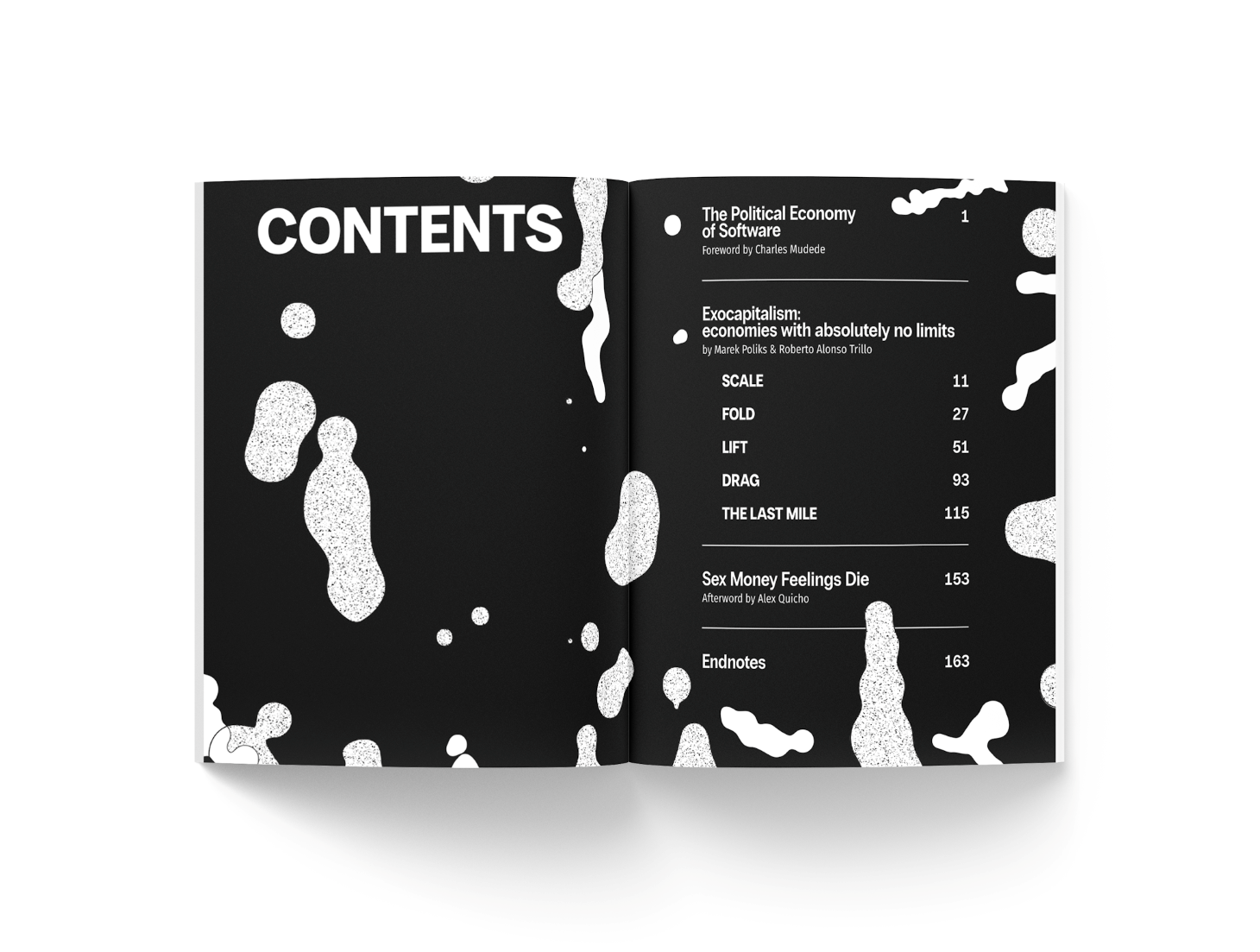
They are the authors of Exocapitalism: Economies with Absolutely No Limits (Becoming Press, 2025; Spanish edition: Exocapitalismo. Economías absolutamente sin límites, Caja Negra, 2026).
Exocapitalism #1: Lift
Lift is the transition from the material to the abstract, from dependence to affiliation, and from production and consumption to fully automatic capital generation. Lifted capital reproduces itself through platform effects, derivatives, loyalty programmes and algorithmic arbitrage. Left in its wake is Drag: the slow, frictional layer of infrastructure still needed to feed, house and move people.
We open with the book's examples, almost all of them Anglo-American or corporate: Delta's boarding groups, Iberia Plus Avios, Telefónica's towers, sold and rented back.
In the final part, we turn the exercise around. Each participant brings a case from their own sector, and together we put it through the same test: where is the Lift here, and where does the Drag remain? Who is still carrying the material layer once capital has left it? For instance, we could set ourselves a goal: to produce a shared inventory of Lift in Spain and Latin America.
Exocapitalism #2: Fold
Software economics and Fold. A side of software economics almost entirely undocumented by contemporary critical theory. Rather than equating software with Silicon Valley ideology, surveillance capitalism or the reductive, and incorrect, label "Big Tech," we read commercial software as a service (SaaS) through the concept of Fold: how software economics proceeds by producing new dimensions of relation. The mechanics of orchestration and containerization in enterprise software architecture; infrastructure as a service (AWS, Azure); the problems of agentic AI; and the rise of Digital Experience Platforms.
Fold is hard to see because it happens between layers. In this session, we will choose together a service that participants use every day (a delivery platform, a bank, a university, a public administration) and unfold it across the wall: who hosts what, who charges whom, where value is added without anything material changing. We trace it downward until we reach AWS or Azure, and upward to the final price.
The Superdark Factory
In this final session, Poliks and Alonso Trillo introduce, for the first time to a Spanish audience, the conceptual framework of the Superdark Factory, their most recent research on automation and a continuation of Exocapitalism. Imagine the most extreme factory possible: one that drives itself, determines its own objectives and optimizes itself to achieve them. Is it possible to define the governance of such a thing? A governance that isn't imposed in advance but renegotiated with what it governs, precisely because nobody knows what it will become.
This is the seventh and final session of the 2026 season of Estudio de Sistemas, a training and creation programme: a regular series of workshops, talks and seminars that aims to foster creative intuition and methodological experimentation around emerging, unstable technologies.
It is part of the annual programme LAB 5 The Mechanics of Truth.

 Medialab-Matadero Madrid